




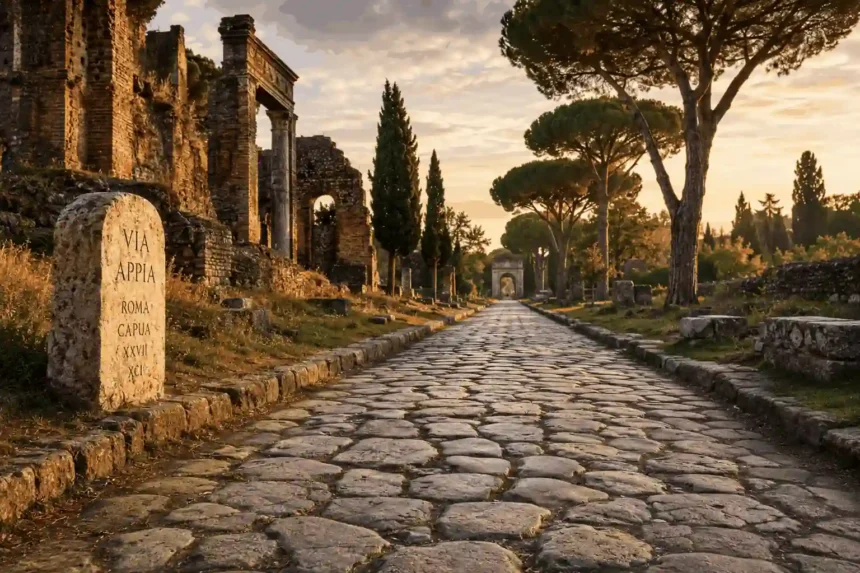
Cesta Roman means Roman road. The term combines “cesta,” meaning road or path in several European languages, with “Roman,” connecting it directly to ancient Rome and its civilization. These were not rough dirt tracks — they were engineered transportation systems that helped one of history’s greatest empires function at scale.
- What Does Cesta Roman Mean?
- The History and Origins of Cesta Roman
- How Big Was the Roman Road Network?
- Why Was Cesta Roman So Important to the Roman Empire?
- How the Cesta Roman Roads Were Built
- Types of Cesta Roman Roads
- Famous Cesta Roman Roads You Should Know
- How Roman Roads Helped Trade and Cultural Exchange Grow
- Archaeological Discoveries and Historical Evidence
- Cesta Roman’s Influence on Modern Roads
- Travel and Tourism: Exploring Cesta Roman Today
- Decline and Preservation Challenges of Roman Roads
- Lessons We Can Learn from Cesta Roman
- Conclusion
- FAQs
- FAQ 1: What does Cesta Roman mean in simple words?
- FAQ 3: How long was the Roman road network?
- FAQ 4: How were the Cesta Roman roads built so strongly?
- FAQ 5: What were the different types of Roman roads?
- FAQ 6: How did Roman roads help trade and communication?
- FAQ 7: How did Cesta Roman impact culture and language?
- FAQ 8: Are Roman roads still visible or used today?
The Roman road network remains one of the most studied infrastructure achievements in human history. It shaped military strategy, economic growth, cultural spread, and even the layout of modern cities. Understanding Roman roads means understanding how Rome actually worked.
What Does Cesta Roman Mean?
The phrase Cesta Roman comes from Latin-influenced European languages, where “cesta” translates to road or path. In Latin, Romans referred to their roads as viae Romanae — not “Cesta Romana.” That version is a modern term that emerged through blogs, online searches, and informal historical writing. It has become widely used because it is simple and easy to remember.
The term refers to the entire Roman road infrastructure — its design, construction methods, geographic reach, and historical purpose. Whether someone searches for Roman roads, viae Romanae, or this modern phrase, they are asking about the same organized, planned road system that connected the Roman Empire from one end to the other.
The History and Origins of Cesta Roman
The First Great Roman Road — Via Appia
Road construction in Rome began seriously around 312 BCE. The first major road, the Via Appia, ran from Rome south into Italy and was built primarily for military movement. Roman armies needed reliable routes to move quickly with equipment and supplies. The Via Appia solved that problem and became the model for every road that followed.
As the empire expanded through conquest and governance, the demand for roads grew rapidly. Government officials needed to reach distant provinces. Merchants needed safe routes. Communication had to move faster than a messenger on foot through open terrain.
Growth of the Road Network
The network expanded in clear phases:
| Phase | Period | Key Development |
| Early Republic | Pre-300 BCE | Basic military paths |
| Expansion Period | 300–100 BCE | Provincial road connections |
| Peak Empire | 100 BCE–200 CE | The 400,000 km network is complete |
| Late Empire | 200–476 CE | Maintenance decline begins |
By the time the network reached its peak, it covered more than 400,000 kilometers and connected regions across three continents.
How Big Was the Roman Road Network?
At its greatest extent, the ancient road network stretched across Europe, North Africa, Asia, and into parts of the Middle East, including modern-day Turkey. France, Spain, and Italy formed the dense core, while coastal cities in North Africa and trade hubs in Asia connected to the wider system.
Rome sat at the center of this continental connection — every major route eventually led back to the capital. Villages, towns, military bases, and ports were all linked into one civilization-wide connectivity system. The scale of this network, measured at over 400,000 kilometers, still impresses engineers and historians today.
Why Was Cesta Roman So Important to the Roman Empire?
Military Mobility
Roman soldiers could cover approximately 30 kilometers per day on paved roads. That speed gave Rome a massive strategic advantage. When rebellions broke out or invasions threatened a region, the army could respond rapidly with full equipment and supplies. Without these roads, controlling such a large and varied territory would have been close to impossible.
Government and Communication
Messages that once took weeks to travel across provinces could now arrive in days. Government officials moved efficiently between Rome and distant territories. Administrative efficiency improved at every level — from tax collection to legal enforcement to military orders. Political control over far-flung regions became practical rather than theoretical.
Trade and Economy
- Grain, wine, olive oil, and cloth moved freely between regional markets
- Merchants used carts and animals on smooth stone surfaces rather than rough paths
- Supply chains developed that fed millions across the empire
- Businesses grew beyond local trade into empire-wide operations
The roads did not just support the economy — they created it.
How the Cesta Roman Roads Were Built
Step-by-Step Construction Process
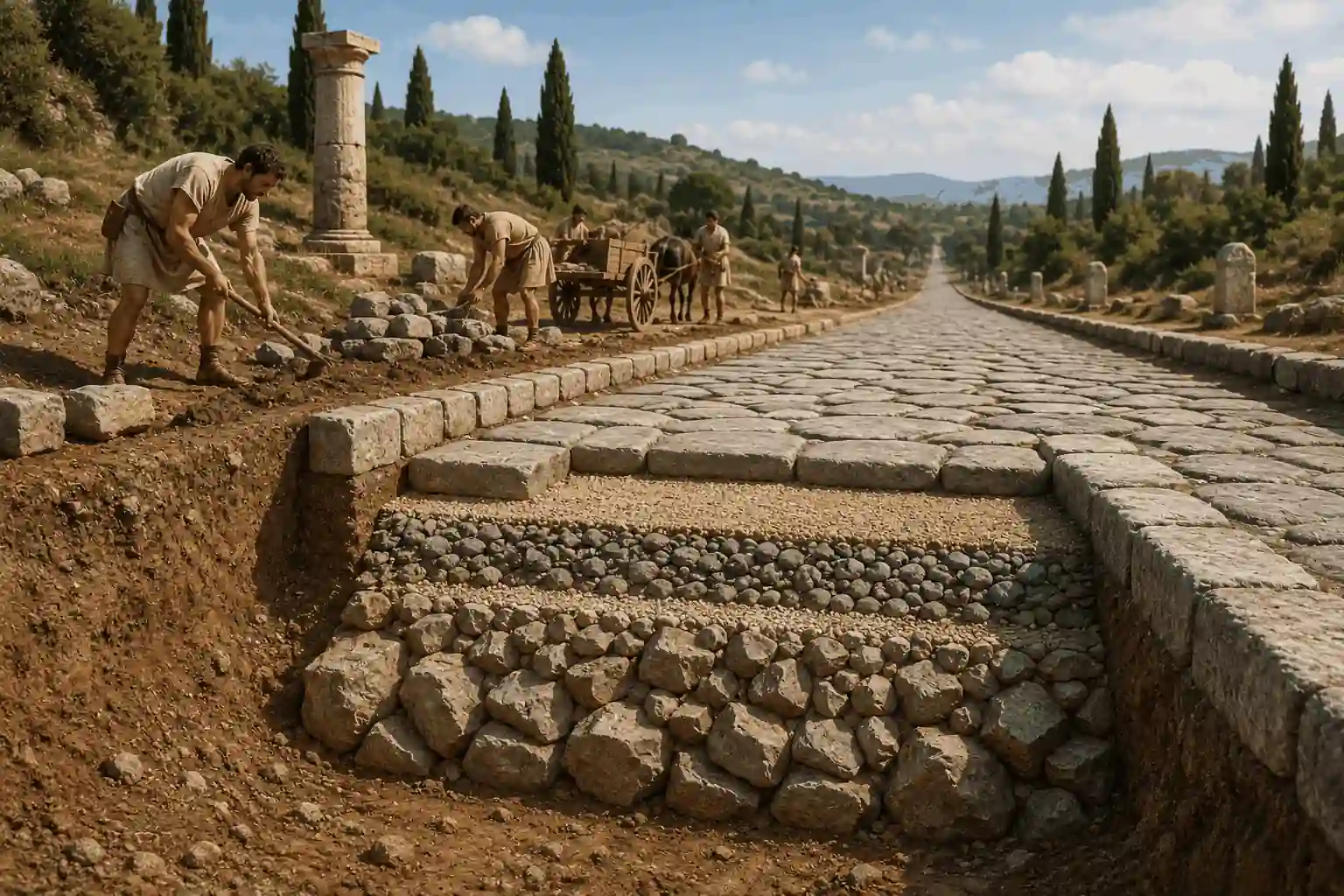
Roman engineers did not improvise. Every road followed a clear construction sequence:
- Survey and planning — Engineers identified the most direct, practical route across the terrain
- Trench excavation — Workers dug a deep trench along the planned path
- Large stone base — Heavy rubble and large stones filled the trench bottom for load-bearing stability
- Gravel middle layers — Smaller stones and gravel added stability and internal drainage
- Flat paving stones — A smooth, wear-resistant surface layer completes the road
The entire process required skilled planning, significant labor, and consistent material quality. Roads built this way carried heavy carts, animals, and armies without breaking down quickly.
Smart Engineering and Design Features
Several design decisions made these ancient roads last far longer than anything built before them:
- Straight-line design — Reduced travel time and simplified navigation across open terrain
- Raised center (camber) — Rainwater drained off to the sides instead of pooling on the surface
- Bridges and tunnels — Rivers and hills were crossed directly rather than avoided
- Elevated pathways — Kept roads above wet or unstable ground in low-lying areas
- Flooding protection — The drainage system made roads usable in all weather conditions
This combination of durability engineering and practical design is why so many Roman roads survived for over two thousand years.
Types of Cesta Roman Roads
The Romans built three distinct road categories depending on purpose and location:
| Road Type | Latin Name | Purpose |
| Main public roads | Viae Publicae | Connecting major cities, built and maintained by the government |
| Secondary roads | Viae Vicinales | Linking towns and villages to the main network |
| Estate roads | Viae Privatae | Private roads built by landowners for farms and local settlements |
This three-tier system created a road backbone that reached almost every corner of the empire. Viae Publicae carried military movements and official communication. Viae Vicinales handled local trade and daily travel. Viae Privatae kept rural communities connected to the broader system.
Famous Cesta Roman Roads You Should Know
Several roads within the network became historically significant enough to carry names still recognized today:
- Via Appia — The Queen of Roads. Built in 312 BCE, it ran from Rome to southern Italy and set the construction standard for all future roads
- Via Aurelia — Ran along Italy’s western coast into France, critical for both military and trade movement
- Via Flaminia — Headed north from Rome into central Italy and connected to France and Spain
- Via Egnatia — One of the most ambitious roads ever built, crossing Greece and into Turkey, linking Europe to Asia
- Via Augusta — Extended Roman road access across Spain, supporting empire expansion routes in the western territories
Each road served a specific strategic or commercial purpose within the larger network.
How Roman Roads Helped Trade and Cultural Exchange Grow
Trade and Economic Expansion
Before these roads existed, moving goods across the ancient world meant slow travel on rough paths that flooded in rain and crumbled in heat. The viae Romanae changed that completely. Merchants moved grain, wine, olive oil, and cloth across the empire-wide markets using smooth stone routes. Carts loaded with products traveled efficiently. Supply chains that once ended at regional borders now stretched across continents.
The result was economic expansion at a scale the ancient world had never seen. Unified markets replaced fragmented local trade. Businesses grew. Cities became wealthier.
Cultural and Social Impact
Roads moved more than goods — they moved ideas. Latin spread across regions as people traveled and communicated along these routes, eventually giving rise to the Romance languages: French, Spanish, Italian, Portuguese, and Romanian. Christianity spread rapidly as missionaries used Roman roads to reach distant communities across the empire.
Traditions, customs, and artistic styles traveled the same paths. Cultural diffusion happened naturally wherever people met, traded, and shared knowledge along major routes. The Europe that emerged from the Roman period — its languages, religions, and city layouts — was shaped directly by where these roads ran.
Archaeological Discoveries and Historical Evidence
Physical evidence of the Roman road system survives across multiple countries. Sections of the Via Appia near Rome remain walkable today and attract thousands of tourists each year. Archaeological sites across France, Spain, and Italy have uncovered original paving stones, bridge foundations, and layered foundation evidence that matches ancient written records almost exactly.
Milestones — stone markers showing distances between cities — have been found along many routes. Road signs, markers, and remains of ancient rest stops give historians detailed information about how ancient logistics and empire administration actually functioned. Ongoing archaeology continues to uncover new sections of the network, expanding the known reach of the system.
Cesta Roman’s Influence on Modern Roads
The engineering legacy of Roman roads did not disappear when the empire fell. Many modern highways across Europe literally follow the same routes that Roman engineers planned thousands of years ago.
| Roman Concept | Modern Equivalent |
| Layered road foundation | Asphalt and sub-base layers |
| Straight-line design | Highway routing principles |
| Raised center drainage | Road camber systems |
| Bridge construction | Modern bridge engineering |
| Centralized network planning | National highway systems |
Roads in Italy, France, and Spain still trace paths first laid out by Roman engineers. The infrastructure design principles introduced through the ancient Roman road system shaped how every major civilization after Rome approached road building.
Travel and Tourism: Exploring Cesta Roman Today
Several preserved sections of ancient Roman roads are open to visitors. The Via Appia outside Rome is the most famous — parts of it remain walkable on original paving stones. Archaeological sites across Italy, France, and Spain maintain stretches of road for tourists and researchers.
Governments and preservation organizations use modern technology to document, restore, and protect surviving sections. Tourism helps fund these efforts while keeping public awareness of Roman engineering alive. For anyone interested in ancient history or civil engineering, walking a section of the Roman road network is one of the most direct connections to the ancient world still available.
Decline and Preservation Challenges of Roman Roads
As the Roman Empire weakened, the road network suffered. Maintaining 400,000 kilometers of road required constant labor, materials, and funding — resources that became harder to secure as central government control deteriorated.
Weather damage, heavy traffic load from carts and armies, and general neglect combined to accelerate deterioration. Floods broke the surface. Vegetation grew over abandoned sections. Later construction buried others entirely. Roads that had lasted centuries fell apart within generations once regular maintenance stopped.
Today, infrastructure survival remains a real challenge. Many sections face ongoing deterioration from modern development, weather, and limited preservation funding. Documentation efforts and archaeological protection continue, but the work is ongoing and not always adequately resourced.
Lessons We Can Learn from Cesta Roman
The Roman road system offers practical lessons that remain relevant in 2026:
- Planning matters more than speed — Roman engineers surveyed and planned carefully before building. That investment in preparation is why their roads lasted.
- Strong foundations are non-negotiable — The layered foundation system created durability that outlasted the empire itself.f
- Infrastructure shapes society — Roads determined where cities grew, how trade developed, and which cultures connected. The same principle applies to modern transportation and digital infrastructure.e
- Maintenance is as important as construction — The network declined not because it was poorly built, but because maintenance stopped. Long-lasting infrastructure requires sustained investment. nt
Conclusion
Cesta Roman represents far more than ancient road construction. It was the operational backbone of one of history’s most powerful civilizations — enabling military strength, trade, communication, and cultural exchange across three continents over more than two thousand years.
The engineering legacy is measurable and physical. Modern highways follow Roman routes. Infrastructure design principles introduced by Roman engineers are still in use. The Romance languages that millions of people speak today spread along these roads. The transportation evolution that Roman roads represented never truly ended — it became the foundation for everything that came after.
FAQs
FAQ 1: What does Cesta Roman mean in simple words?
Cesta Roman means Roman road. “Cesta” translates to “road” or “path” in several European languages, and “Roman” links it to ancient Rome. The Romans themselves used the Latin term viae Romanae, while Cesta Roman is a modern phrase used in blogs and online searches today.
FAQ 2: When did the Romans start building Cesta Roman roads?
Organized Roman road construction began around 312 BCE with the Via Appia, which connected Rome to southern Italy. It was built initially for military movement and became the model for the entire network.
FAQ 3: How long was the Roman road network?
At its peak, the network covered more than 400,000 kilometers. It extended across Europe, North Africa, and Asia, connecting cities, towns, military bases, and ports across three continents.
FAQ 4: How were the Cesta Roman roads built so strongly?
Roads were built using a layered foundation — large stones at the base, gravel in the middle layers, and flat paving stones on top. A raised center allowed rainwater drainage, and bridges or tunnels handled terrain obstacles. This method produced roads that lasted over 2,000 years.
FAQ 5: What were the different types of Roman roads?
The Romans built three main categories: Viae Publicae (main public roads connecting major cities), Viae Vicinales (secondary roads linking towns and villages), and Viae Privatae (estate roads built by landowners for private use). Each type served a different function within the broader network.
FAQ 6: How did Roman roads help trade and communication?
Merchants transported grain, wine, olive oil, and cloth across the empire-wide markets using these roads. Government officials and messengers moved faster, reducing communication delays across distant provinces. The roads directly supported trade routes and the empire’s economy.
FAQ 7: How did Cesta Roman impact culture and language?
Latin spread along these routes and eventually evolved into the Romance languages — French, Spanish, Italian, Portuguese, and Romanian. Christianity spread through missionary travel on Roman roads. Cultural exchange, idea diffusion, and shared traditions followed the same paths that goods and armies used.
FAQ 8: Are Roman roads still visible or used today?
Yes. Sections of the Via Appia near Rome remain walkable on original paving stones. Many modern highways across Italy, France, and Spain follow routes first planned by Roman engineers. Archaeological sites preserve surviving sections, and tourism supports ongoing preservation efforts as of 2026.