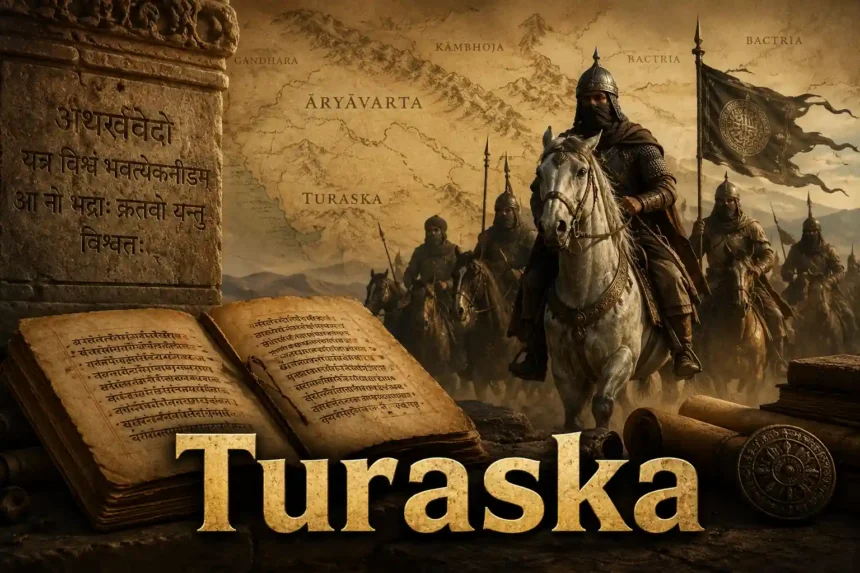
Turaska is an ancient Sanskrit-origin term documented in major Indian classical texts, where it was used to describe Turkic and Central Asian peoples who lived beyond the northwestern borders of the Indian subcontinent. Found in works like the Mahabharata and the Vishnu Purana, the word carried a shifting identity over centuries — sometimes a geographic label, sometimes a cultural marker, and sometimes a reference to political power. Understanding Turaska means understanding how ancient Indian writers saw the world beyond their borders and named what they found there.
The Sanskrit Root: Where Turaska Comes From
The word Turaska is closely linked to two older Sanskrit forms: Turuska and Turushka. These are not modern coinages. Scholars have traced both forms in classical Indian literature going back well over a thousand years.
In Sanskrit, compound or borrowed terms often adapted the sounds of foreign peoples into the phonetic rules of the language. Turushka followed this pattern. The root appears to reference Turkic-speaking peoples — nomadic and semi-nomadic groups whose origins lay in Central Asia, particularly the steppe regions stretching from modern-day Kazakhstan and Uzbekistan westward into Iran and eastward into China.
Over time, regional pronunciation and manuscript copying led to variations. Turuska, Turushka, and Turaska all appear in different texts and translations. These forms should be understood as related, not as separate terms with separate meanings.
Turaska in Ancient Indian Texts
The clearest evidence for how the word was used in early South Asian writing comes from three major works.
The Mahabharata
The Mahabharata, one of the two great Sanskrit epics of ancient India, contains references to the Turuska peoples among the lists of foreign nations and tribes known to the epic’s world. These are not central characters in the story, but their mention confirms that knowledge of Central Asian groups existed in the Indian literary tradition from a very early date.
The Vishnu Purana
The Vishnu Purana, a text believed to have been composed between the 1st and 4th centuries CE, includes Turushka as one of the communities associated with the northwestern frontier. The Puranic texts used such terms as part of broader descriptions of the known world, listing peoples by direction and region.
The Bhavishya Purana
The Bhavishya Purana, whose composition spans a wider time range and includes later additions, uses Turaska in contexts that touch on foreign rulers entering India. Some scholars treat this text’s references with more caution since later sections were added in the medieval period, but the term’s presence there reinforces how long it remained in active use.
Who Did the Word Describe?
This is where the term becomes genuinely interesting for historians and language scholars.
Turaska did not have a fixed, narrow definition. In some passages, it referred broadly to people from the northwest — Central Asians, Iranians, or groups the Indian writers considered outsiders. In others, it became more specifically associated with Turkic-speaking peoples, particularly after waves of migration and conquest brought Turkic groups into closer contact with South Asia.
The Wikipedia entry for Turushka notes that the Sanskrit word was also used as a descriptor for Muslims more broadly, whether or not those individuals were ethnically Turkic. This is significant. It shows how a geographic-ethnic label gradually became a religious-cultural one in the Indian literary imagination, especially as Turkic Muslim dynasties became the dominant political power in northern India from the 10th century onward.
So the word carried at least three overlapping meanings at different times:
- A label for Central Asian or Turkic ethnic groups
- A term for people from the northwestern frontier region
- A broader descriptor for Muslim rulers and communities in a medieval Indian context
How the Meaning Shifted Across History
The following table maps the evolution of this term across roughly two millennia:
| Period | Primary Use of Turaska/Turushka | Context |
| Pre-5th century CE | Label for Central Asian tribes | Found in epics and early Puranas |
| 5th–10th century CE | Reference to the Turkic peoples on the frontier | As steppe migrations intensified |
| 10th–13th century CE | Associated with Turkic Muslim rulers | Following the Ghaznavid and Ghurid conquests |
| 13th–16th century CE | Sometimes used interchangeably with “Muslim.” | Broader cultural-religious identity marker |
| Modern scholarship | Historical linguistic term | Studied in Sanskrit literature and South Asian history |
This evolution is not unusual. Words in every language carry historical baggage. What makes Turaska notable is how clearly its shifts track with real political and demographic changes on the Indian subcontinent.
Turaska and Medieval India
By the time the Delhi Sultanate was established in 1206 CE, Turkic rulers had been entering northern India for over two centuries. The Ghaznavid raids under Mahmud of Ghazni (971–1030 CE) and the Ghurid conquests that followed brought Turkic military commanders and administrators into sustained contact with Indian societies.
In this context, Indian writers — both Sanskrit scholars and later vernacular authors — continued using terms like Turaska to describe this incoming population. The word was already familiar from their textual inheritance, so applying it to the new rulers made sense within the existing vocabulary.
Historians studying medieval Indian texts use Turaska as an evidence point when analyzing how Indian writers categorized foreign groups. The term appears in court literature, religious commentaries, and administrative texts, showing that it remained active across different registers of writing.
It is worth noting that the people described as Turaska rarely called themselves by that name. These were external labels — the way one group names another. This is common in historical linguistics and does not reduce the term’s scholarly value.
The Word in Modern Scholarship
Today, Turaska is not in everyday spoken use. It lives primarily in:
- Sanskrit studies, where scholars analyze classical and medieval texts, encounter it regularly
- South Asian history, where researchers studying the Delhi Sultanate, Mughal-era texts, and pre-Islamic India use it as an analytical category
- Linguistics, where the relationship between Sanskrit loanwords, borrowed sounds, and foreign-people terminology is a documented research area
The related Wikipedia article on Turushka also notes that in Sanskrit, the word turushka could refer to frankincense (olibanum) — a separate meaning entirely unrelated to the ethnic or political use. This polysemy (one word, multiple meanings) is another reason scholars read the term carefully in context.
For general readers, the most important takeaway is that Turaska is a real historical term with documented appearances in verifiable classical Indian texts. It is not a modern invention, not a brand, and not a vague internet term. It belongs to the serious study of South Asian linguistic and cultural history.
Turaska in 2026: Why People Search for It
Interest in terms like Turaska has grown in 2026 alongside wider public curiosity about Sanskrit etymology, ancient Indian history, and the roots of South Asian identity. Platforms discussing Indian classical literature, historical linguistics, and civilizational history have brought older scholarly terms into broader online conversation.
For students of history, language researchers, or anyone exploring how ancient Indian writers described the world beyond their borders, the term offers a meaningful entry point into a rich and often underexplored area of scholarship.
Conclusion
Turaska is a small word that opens a large door. Its roots lie in Sanskrit, its evidence sits in some of the most important texts in the Indian literary tradition, and its shifting meanings track centuries of contact, conflict, and cultural exchange between South Asia and the wider world to its northwest.
For anyone interested in how ancient writers named foreign peoples, how identity labels evolve with history, or how Sanskrit literature recorded a changing world, this term rewards careful attention. It is not a buzzword or a modern coinage — it is a documented piece of South Asian linguistic history that continues to matter in 2026 for all the right scholarly reasons.
FAQs
Q1: What does Turaska mean?
Turaska is an ancient Sanskrit-origin word that was used in classical Indian texts to refer to Turkic and Central Asian peoples, particularly those living beyond India’s northwestern frontier. Over time, its meaning expanded to include broader associations with Muslim rulers and communities in medieval India.
Q2: Where does the word Turaska appear in ancient texts?
It appears in major Sanskrit texts,s including the Mahabharata, the Vishnu Purana, and the Bhavishya Purana. The closely related forms Turuska and Turushka are found in various manuscripts and scholarly editions of these works.
Q3: Is Turaska the same as the Sanskrit word Turushka?
Yes, essentially. Turaska, Turuska, and Turushka are variant forms of the same root term, shaped by regional pronunciation, manuscript traditions, and translation conventions. They all refer to the same historical concept.
Q4: Did the meaning of Turaska change over time?
It did. Originally an ethnic-geographic label for Central Asian and Turkic groups, it gradually became associated with Turkic Muslim rulers who entered India from the 10th century onward. In some later texts, it functioned as a broader descriptor for Muslim identity in a South Asian context.
Q5: Is Turaska used in modern languages?
Not in everyday speech. The term is primarily encountered today in Sanskrit scholarship, South Asian historical research, and academic discussions of classical Indian literature. It is a historical linguistic term, not a word used in contemporary Indian languages in its Sanskrit form.