



The Delta flight DL636 diversion quickly drew attention from aviation trackers, passengers, and safety analysts alike. This article breaks down exactly what happened, why it matters, and what it signals for long-haul aviation in 2026.
- What Is the Delta Flight DL636 Diversion?
- What Caused the Delta Flight DL636 Unscheduled Landing?
- How Delta Responded After Landing at LAX
- Safety Protocols and Aviation Regulations Under Review
- How Does This Compare to Recent Aviation Incidents?
- What This Means for Passengers and Future Air Travel
- Conclusion
- FAQs
- Why did Delta Flight DL636 divert to LAX?
- What aircraft was used on Delta Flight DL636?
- What route does Delta Flight DL636 operate?
- What happened to passengers after the DL636 diversion?
- Is the Delta Flight DL636 diversion under FAA investigation?
- How common are flight diversions in U.S. aviation?
- What safety protocols are triggered during a mid-air diversion?
- How can travelers protect themselves after a flight diversion?
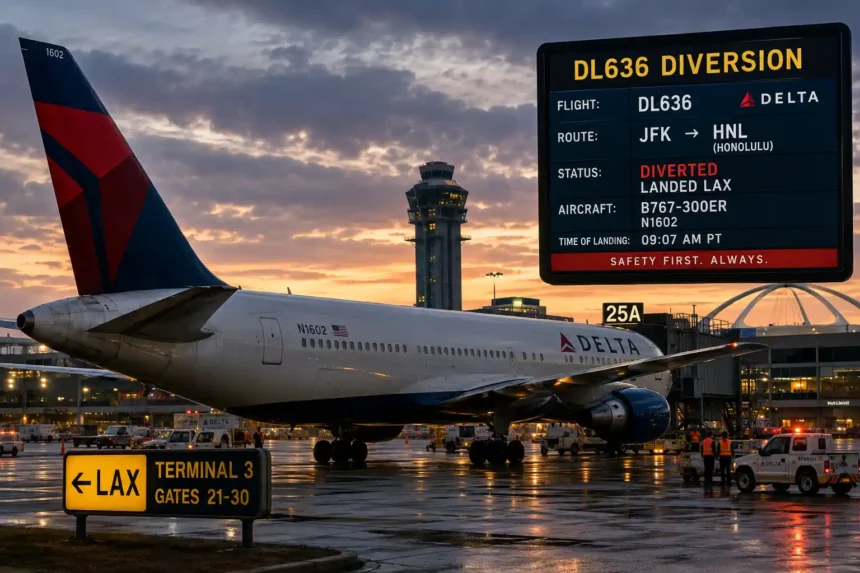
On September 7, 2025, Delta Air Lines flight DL636 diverted to Los Angeles International Airport (LAX) while en route from New York’s John F. Kennedy International Airport to Honolulu. The aircraft — a 26-year-old Boeing 767-300ER registered as N1602 — never completed its scheduled transcontinental service to Hawaii. Instead, it landed at LAX, interrupting travel plans for hundreds of passengers mid-Pacific journey.
What Is the Delta Flight DL636 Diversion?
Delta Flight DL636 operates one of the longest domestic routes in the U.S. — from JFK in New York to Honolulu International Airport (HNL) in Hawaii, covering approximately 4,980 miles in about 10 hours and 58 minutes over the Pacific Ocean.
On September 7, 2025, the flight departed JFK as scheduled. Midway through the journey, flight tracking data showed the Boeing 767-300ER adjusting its trajectory toward the West Coast instead of continuing southwest toward the islands. The aircraft diverted to LAX — a major Delta hub with full maintenance and operational infrastructure.
After landing, Delta scheduled a follow-up departure from Gate 25A at 2:30 p.m. local time, allowing passengers to continue their trip to Honolulu on an adjusted itinerary.
What Caused the Delta Flight DL636 Unscheduled Landing?
Mechanical Failure and In-Flight Warning Signs
The diversion traces back to a reported loss of pressure in the aircraft’s hydraulic system — the network of fluid-powered components that controls critical flight surfaces. When pressure dropped in the main flight controls, the flight deck received multiple warning signals before the crew made the call to divert.
Passengers reported detecting fumes in the cabin, and the aircraft’s cooling systems showed signs of stress during the descent. The mechanical warning light had triggered earlier in the flight, which the crew responded to by initiating a controlled emergency descent in line with strict safety guidelines.
The Boeing 767-300ER is equipped with advanced avionics and redundant systems designed to catch irregularities early. These automated alerts gave the flight crew enough lead time to make a safe, organized decision — rather than an emergency scramble.
Ground Maintenance and Pre-Flight Oversight
Analysis of the incident points to a recurring sensor error that may have been present during the aircraft’s previous ground inspection. The jet was already scheduled for a heavy maintenance check the following month, raising questions about whether the inspection cycle had left a known issue unresolved.
Maintenance logs for N1602 came under federal review by the FAA shortly after the diversion. Spare parts shortages — a growing problem across the airline industry — are also suspected to have delayed some routine maintenance tasks before the flight departed.
Delta’s TechOps division, which handles the carrier’s maintenance operations, was brought in at LAX to conduct a full diagnostic once the aircraft landed. Predictive maintenance analytics, which Delta has invested in to catch failures before departure, remain a focus of the post-incident review.
How Delta Responded After Landing at LAX
Once the Boeing 767-300ER touched down safely at Terminal 3, Delta moved quickly. Ground crews facilitated deplaning, and re-accommodation processes were activated for all affected passengers.
The airline’s response included:
- Rebooking options onto later flights to Honolulu or alternative carriers through SkyTeam partnerships
- Complimentary refreshments and lounge access for eligible SkyMiles members
- Vouchers issued to passengers whose onward travel was significantly disrupted
- A rescheduled departure from Gate 25A at 2:30 p.m. for those continuing the same day
One area of criticism was the airline app, which failed to update flight status in real time for passengers waiting at the gate. Many travelers were left piecing together information from staff announcements rather than digital notifications — a gap in Delta’s communication protocols that compounded confusion around connecting flights.
Ground crews worked through the afternoon, inspecting the landing gear and hydraulic lines before clearing the aircraft for its next service.
Safety Protocols and Aviation Regulations Under Review
Flight Crew and Air Traffic Control Response
The flight crew’s handling of the situation drew measured praise from aviation safety analysts. After the mechanical warning light appeared and fumes were detected, the pilots followed established protocols: notify air traffic control, request priority routing, and initiate a controlled descent.
Air traffic control cleared a path through heavy weather conditions to facilitate the landing at LAX, coordinating with ground teams for an expedited arrival. Emergency services met the plane on the runway as a standard precautionary measure — not because the situation had escalated to a full emergency.
Flight recorders captured all crew communications and system data during the descent, and that data feeds directly into the ongoing investigation to determine whether every protocol was followed correctly.
FAA and NTSB Investigation
The FAA launched a review of N1602’s maintenance logs immediately following the diversion. The NTSB is also involved in assessing whether the incident reflects a systemic gap or an isolated mechanical fault.
The final report is expected to take several months to complete. Investigators are examining the tail number’s full service history, spare parts procurement records, and whether the pre-flight inspection process met federal standards. The Department of Transportation has separately flagged the airline industry’s overall fleet age as a growing concern, with pressure building for updated international standards across carriers.
How Does This Compare to Recent Aviation Incidents?
The DL636 diversion is not happening in isolation. A string of notable incidents in 2025 and 2026 has put aviation safety under sharp scrutiny:
| Flight | Incident Type | Diversion Location |
| Delta DL636 | Hydraulic Failure | Los Angeles (LAX) |
| Delta DL555 | Operational Delay | New York (JFK) |
| Delta DL2417 | Interior/Ceiling Damage | Los Angeles (LAX) |
| Delta DL1800 | Cancellation | — |
| Air France AF123 | Engine Issue | Madrid (MAD) |
| British Airways BA286 | Emergency Diversion | — |
| AA9600 | Flight Diversion | London |
Two concerns keep appearing across these incidents: structural integrity and hydraulic reliability. Aviation analysts note that aging fleet assets, combined with industry-wide spare parts shortages, are creating conditions where minor faults escalate more quickly than they should.
The Delta flight DL555 stranded passengers incident, and the Delta flight 2417 ceiling collapse both made national headlines within the same news cycle — signaling that these are not random outliers but part of a pattern worth monitoring in 2026 air travel.
What This Means for Passengers and Future Air Travel
Passenger Rights and Immediate Impact
Passengers affected by the DL636 diversion are entitled to compensation depending on the circumstances — though Delta cited “safety necessity” as the basis for the diversion, which can limit certain claims under current airline policy.
Travelers who want to stay ahead of situations like this should:
- Check aircraft age before booking long-haul routes — tools like FlightAware provide tail number and fleet history data
- Set up real-time flight tracking alerts through third-party apps, since airline apps can lag during disruptions
- Know your rebooking rights — under DOT guidelines, passengers are entitled to full refunds or rebooking if a flight fails to reach its destination.
- Have a backup plan at major hubs — LAX, JFK, and ATL all have multiple same-day options to Hawaii if diversions occur. ur
Legal counsel was sought by some DL555 passengers in an earlier case, and similar discussions have emerged following DL636, particularly around compensation for grounded subsequent flights and hotel costs.
Industry-Wide Implications and Fleet Safety
The DL636 diversion adds weight to a broader conversation about fleet modernization across the airline industry. The Boeing 767-300ER has been a reliable long-haul aircraft, but aging frames require more frequent heavy checks — and when those checks are delayed by spare parts shortages or compressed maintenance schedules, the risk compounds on overwater segments where diversion options are limited.
International carriers face the same pressure. The British Airways BA286 emergency and the AA9600 London diversion both reflect the fact that global maintenance standards are uneven, and weather patterns over major ocean corridors can amplify existing mechanical issues.
The transportation sector is increasingly looking at predictive AI as a front-line tool — capable of flagging sensor irregularities before an aircraft leaves the gate rather than mid-flight over the Pacific. Delta has invested in this direction, but the DL636 incident suggests the gap between investment and consistent implementation remains real. Consumer trust, fuel costs, and voucher payouts from a single diversion easily reach into the millions — making early detection far cheaper than reactive response.
Conclusion
The Delta flight DL636 diversion on September 7, 2025, was a controlled, professionally managed response to a serious hydraulic failure — and that part worked. The flight crew acted within safety guidelines, air traffic control cleared the path, and Delta mobilized resources at LAX efficiently.
But the incident also exposed persistent gaps: aging aircraft in active long-haul service, maintenance log concerns now under FAA and NTSB review, and communication breakdowns that left passengers without reliable real-time information. As the aviation industry reaches a crossroads in 2026 over fleet age and passenger safety standards, events like DL636 serve as concrete data points — not anomalies, but signals.
FAQs
Why did Delta Flight DL636 divert to LAX?
Delta Flight DL636 diverted to LAX due to a hydraulic system failure that caused loss of pressure in the main flight controls. Mechanical warning lights activated during the flight, and the crew followed standard safety protocols by routing to the nearest major hub equipped for emergency maintenance.
What aircraft was used on Delta Flight DL636?
The flight operated on a Boeing 767-300ER registered as N1602. The aircraft was 26 years old at the time of the diversion and was already scheduled for a heavy maintenance check the following month.
What route does Delta Flight DL636 operate?
DL636 runs from New York’s John F. Kennedy International Airport (JFK) to Honolulu International Airport (HNL) in Hawaii. The route covers approximately 4,980 miles and takes around 10 hours and 58 minutes over the Pacific Ocean.
What happened to passengers after the DL636 diversion?
Passengers deplaned at Terminal 3 in LAX. Delta offered rebooking onto later Honolulu-bound flights, SkyTeam partner options, SkyMiles lounge access, complimentary refreshments, and vouchers. A same-day departure was rescheduled from Gate 25A at 2:30 p.m.
Is the Delta Flight DL636 diversion under FAA investigation?
Yes. The FAA initiated a review of N1602’s maintenance logs following the diversion. The NTSB is also involved. The final report is expected to take several months, with investigators examining the aircraft’s full service history and pre-flight inspection records.
How common are flight diversions in U.S. aviation?
Diversions occur in less than one percent of U.S. commercial flights annually. They are more closely monitored on overwater and long-haul segments, where fewer diversion options exist, and the consequences of continuing with a mechanical issue are more severe.
What safety protocols are triggered during a mid-air diversion?
When a diversion is initiated, the flight deck notifies air traffic control, requests priority routing, and begins a controlled descent following established safety guidelines. Flight recorders capture all communications and system data. Emergency services are positioned on the runway as a precautionary measure.
How can travelers protect themselves after a flight diversion?
Check aircraft age and tail number history using tools like FlightAware before booking. Set real-time tracking alerts through third-party apps. Know your DOT rebooking and refund rights. When flying through major hubs like LAX or JFK, research same-day alternative flights to your destination in advance.